

Lowe Masters the Icebreaker at Thompson
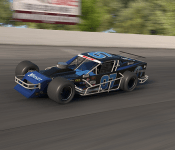
Thompson, CT — The Yesteryear Racing Tour Modified Series arrived at Thompson Speedway like a thunderclap in a steel canyon, and the “Icebreaker” delivered exactly what its name promised: a cold, unforgiving test of discipline, timing, and raw nerve. Modeled after the historic 2009 NASCAR Wheeled Modified Tour event, the 150-lap showdown turned the high-banked 5/8-mile oval into a gladiator’s arena, where one misstep meant being swallowed by the wall or stranded in the dreaded marbles.
From the drop of the green, the spotlight burned brightest on Luke Logan Allen, the points leader carrying the swagger of “Kid Lemon Lime,” and Eric “Teapot” Stout, who rocketed to pole but entered the night desperate to claw out of an early-season hole. Their duel didn’t simmer, it detonated. Allen wasted no time unleashing his high-line momentum, sweeping around Stout with authority to seize control as the field snapped into a tight, high-speed draft line.
For the opening stretch, the race resembled a coiled spring. Twenty-one drivers ran nose-to-tail, each probing for the smallest crack in the armor ahead while tiptoeing along the razor-thin groove. Venture half a lane too high, and the marbles waited like ball bearings underfoot. The tension finally snapped around lap 50 when Lloyd Moore slapped the wall navigating lap traffic, bringing out the first major caution and cracking open the strategy playbook.
Most of the leaders chose the conservative route, clinging to track position like it was gold bullion. But Kenny Allen and Jerry Isaacs rolled the dice, diving to pit road for fresh tires in a bold attempt to flip the race on its head later. It was a gambler’s move in a race that rewarded patience, but punished hesitation.
Up front, the pressure cooker intensified. Stout stalked Allen with surgical precision, waiting for the slightest miscue. When it came, it was dramatic. Allen got loose off turn four, the rear stepping out in a moment that could have ended his night. He caught it in a dazzling save, but the cost was steep. Momentum gone, positions lost, and suddenly the hunter became the hunted. Stout reclaimed the lead but now had James Lowe and Chris Worrell looming in his mirrors like storm clouds.
The race pivoted again during a late caution involving Kenny Allen and Isaacs, effectively neutralizing the alternate strategy. With about 45 laps to go, Stout faced a brutal decision. Stay out and risk being trapped on the inside line, or pit and surrender control. He chose fresh tires, a calculated gamble that dropped him deep in the field but armed him for a late charge.
That decision handed the front row to teammates James Lowe and Chris Worrell, who stayed out on worn tires, choosing track position over grip. What followed was pure short track theater. Cars slid, bumped, and clawed for every inch. Eric Essary surged into contention on fresher rubber, slicing through traffic with urgency before a late spin derailed his podium hopes.
Behind them, Stout carved through the field like a man on a mission, each pass a small act of redemption. And then, just as the race approached its final heartbeat, another twist: Brian Neff, who had quietly held a podium position for 147 laps, abruptly pulled off track on the brink of the white flag, vanishing from contention in one of the night’s biggest mysteries.
At the front, it was a test of resolve. Lowe, balancing a car on aging tires and sheer determination, held off his teammate in the closing laps to capture his first win of the season. The 1-2 finish stamped their authority on the night, while Stout’s bold strategy paid off with a hard-earned third after his relentless charge through the pack.
Todd Liston and Luke Logan Allen completed the top five, the latter recovering admirably after his earlier misstep but left to wonder what might have been.
In a race defined by razor-thin margins and high-stakes decisions, James Lowe proved that sometimes the winning move isn’t the flashiest one. It’s the ability to stay planted at the front, dance on the edge of control, and refuse to blink when the pressure closes in. At Thompson, that was the difference between surviving the Icebreaker and owning it.




 Virtual Grip Network