Sirois Survives Pocono Chaos to Capture Strategic Victory
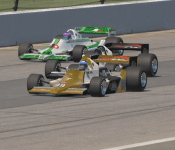
Long Pond, PA — The Sim Gaming Expo ISRA Retro Series returned for Round 9 with a 75-minute showdown at Pocono Raceway, where the ground-effect Lotus 79s transformed the “Tricky Triangle” into a high-speed chess match of fuel management, drafting, and survival.
The unusual combination of a 1970s Formula car and Pocono’s three distinct corners created a unique challenge for the field. With Turn 1 inspired by the old Trenton layout, Turn 2 modeled after Indianapolis, and Turn 3 based on the Milwaukee Mile, drivers had to master three completely different sections of track in every lap.
To reduce extreme fuel-saving tactics, the series implemented a slightly larger 30% fuel cell for the event. However, drafting remained a critical part of the strategy as competitors searched for every possible advantage over the long Pocono straights.
Vern Hawkins captured the pole position, with Mike Goodman starting alongside on the front row. Mike Rigney and Lewis Hayes occupied the second row, while championship leader David Sirois began the race from seventh.
Lionel Calisto chose not to set a qualifying time, forcing the “Little Train” to start from the rear of the 19-car field.
When the green flag waved, Hawkins immediately took control, leading the field into Turn 1. The opening laps featured constant movement throughout the pack as drivers searched for clean air and the best drafting partners.
Chris Stofer quickly became one of the race’s biggest movers, climbing from 12th into the top ten during the opening laps. Meanwhile, Richie Hearn showcased the pace expected from his real-world IndyCar background, slicing through the field and moving into second place by Lap 14 as he began pressuring the leaders.
By Lap 25, the race had begun to settle into its first major rhythm. Chris Stofer completed an impressive charge through the field, eventually reaching the lead as the front pack continued to rotate positions through the draft.
The first pit cycle arrived around Lap 28, matching the expected fuel range of the Lotus 79. Vern Hawkins was among the first leaders to make his stop, while Craig Forsythe stretched his fuel run longer and inherited the lead once the cycle completed.
A major storyline during the middle portion of the race was the teamwork among the Chilean contingent of Hugo Galaz and Rodrigo Munoz, who worked together through the draft to close the gap to the leaders.
Matt Wagner, nicknamed the “Ovalmeister,” also enjoyed his time at the front, taking command on Lap 33 as the lead continued to change hands throughout the draft pack.
The second and final round of pit stops arrived with roughly 25 minutes remaining.
Several drivers committed to different strategies. David Sirois, Alex Guyon, and Lewis Hayes stayed out longer than much of the field, attempting to stretch their fuel window and avoid a late splash-and-dash stop.
Meanwhile, drivers who had committed earlier to pit road faced a difficult final stint, forced either to conserve fuel or surrender track position.
As the clock wound toward the final five minutes, the race transformed into a spectacular battle.
A 13-car train formed at the front, with the Lotus 79s racing inches apart at nearly 200 mph. The long Pocono straights produced multiple three-wide and four-wide battles as Lewis Hayes, Craig Forsythe, Lionel Calisto, and Mike Rigney fought for control of the lead pack.
The entire field appeared poised for a dramatic finish. Then everything changed. With less than a minute remaining, the lead group entered a furious four-wide battle for victory. Contact occurred in the pack, with Forsythe later describing the incident as a “netcode” issue.
The result was devastating. Lewis Hayes was launched upside down, while several other contenders scattered through the aftermath. The chaos unfolded directly in front of David Sirois, who had positioned himself perfectly to capitalize.
The caution flag flew as the race timer expired, freezing the running order and sending the field to the finish under yellow.
David Sirois captured the victory, extending his championship lead with a perfectly timed combination of strategy and survival.
Calisto’s podium performance was one of the standout drives of the afternoon. Starting from the rear of the field, the “Little Train” charged forward 15 positions to secure a top-three finish.
In post-race interviews, Sirois admitted that the victory had an element of fortune, explaining that being in the right place when the caution fell ultimately decided the race.
Forsythe reflected on the closing incident with frustration, believing Lewis Hayes had a legitimate opportunity for a podium finish before the late-race chaos unfolded.
Once again, Pocono proved that in the ISRA Retro Series, speed alone is never enough. At the Tricky Triangle, the winners are the drivers who can manage the fuel, the draft, and the madness when the final pieces of the puzzle fall into place.