Roth Breaks Through at Langley as Lowe Extends Championship Lead
The BRL Bush Talk Radio Super Late Model Series rolled into the historic Langley Speedway for Round 9, bringing its high-horsepower machines to one of the tightest and most demanding bullrings on the schedule. At just 0.395 miles around, Langley leaves very little room for error. The flat corners and narrow racing surface make the bottom groove the place to be, while the tremendous horsepower of the Super Late Models means drivers have to be exceptionally careful with the throttle. Get back to the gas just a little too aggressively and the rear tires can quickly become the driver’s worst enemy.
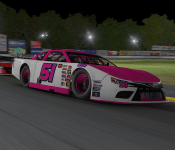
With the championship battle already razor thin, the pressure was especially high heading into the 100-lap contest. James Lowe entered the evening with only a one-point advantage over Chris Worrell, leaving virtually no room for either driver to have an off night. Qualifying would be particularly important at a track where passing is notoriously difficult, and Charles Roth made the most of the opportunity by putting his No. 51 on the pole alongside Steve Hilbert. Kurt Smith, James Lowe, and Ruben Altice rounded out the top five.
One of the biggest stories before the green flag was Luke Logan Allen. The No. 31 had been the fastest driver in practice with a lap of 15.405 seconds, but despite his impressive speed, Logan found himself starting all the way back in 17th. That meant the young driver would have to work his way through the field on a track where passing is anything but easy.
When the green flag waved, Roth immediately took control of the race. The No. 51 launched cleanly and quickly built a three-car-length advantage as the field settled into the opening laps. Behind him, however, the tight confines of Langley were already beginning to claim victims.
Cold tires and the massive torque of the Super Late Models proved to be a dangerous combination, with Eric Stout bringing out the first caution after spinning. The early laps also saw plenty of shuffling throughout the field, with Chris Davis and championship contender Chris Worrell among those finding themselves caught in the wrong lane. The high groove offered little grip or momentum, and drivers attempting to make the outside lane work often found themselves losing positions in a hurry.
While the leaders tried to establish a rhythm, Luke Logan Allen began his march from the rear. The No. 31 steadily picked his way through the field, displaying the kind of patience and precision needed to survive Langley. Before long, “The Kid Lemon Lime” had transformed a 17th-place starting position into a spot among the top five.
The charge wasn’t entirely without drama. Logan’s aggressive line through Turn 1 had the broadcast team taking notice, with the No. 31 diving extremely low into the corner and occasionally upsetting the balance of the car. Still, the strategy was working, and Logan continued to move forward.
The middle portion of the race became increasingly chaotic. John Wilson and Chris Haizlip were among the drivers caught up in the constant mid-pack battles, while the field began encountering what the broadcast team dubbed the “Cone of Danger.” At Langley, the critical moment comes when a lead car reaches the point where it should begin accelerating off the corner. A following driver anticipates that acceleration, only to find the car ahead hesitating. With nowhere to go and almost no room to react, contact can happen in an instant.
That scenario played out during a backstretch incident involving Steve Hilbert and Joseph Snyder, with Jeff Sharp also getting collected. Kurt Smith was later caught up in a netcode incident that further scrambled the running order. With cautions continuing to interrupt the race, maintaining momentum became increasingly difficult for everyone.
At the front, however, Charles Roth remained the man to beat.
The championship implications became even more significant as the race entered its final stages. James Lowe repeatedly found himself in the wrong place at the wrong time on restarts, being forced into the outside lane where the car simply could not generate the same momentum as those running the bottom. With eight cautions throughout the race, Lowe was repeatedly forced to recover from the same disadvantage.
Rather than allow himself to remain trapped on the outside, Lowe developed a strategy of his own. On several restarts, the championship leader would voluntarily drop from second to third, sacrificing a position in order to get back onto the preferred bottom groove. Once there, he could begin working his way forward again.
It was a frustrating cycle. Lowe would work his way back to Roth’s bumper, only for another caution to erase the progress and put him back into the restart shuffle.
With the race winding down, it became a battle of patience between Roth and Lowe. The No. 99 needed only the slightest opportunity to make a move, but Roth refused to give him one.
In the closing two laps, with just 26 seconds remaining on the clock, Lowe made one final attempt to get underneath the No. 51. Roth held his line on the apron and positioned his car perfectly, leaving Lowe with nowhere to make the move. There would be no opportunity to root and gouge his way past. Roth kept the No. 51 pointed in the right direction and held on to claim the biggest victory of his BRL career.
For Roth, the victory marked his first career BRL win in his 38th start. The wire-to-wire performance was a breakthrough moment for the driver, who had spent plenty of races knocking on the door of victory.
Lowe crossed the line second, frustrated by the repeated struggles on the outside lane but nevertheless walking away with an important championship result. His runner-up finish allowed him to extend his championship advantage to three points over Worrell.
Ruben Altice came home third, followed by Chris Worrell in fourth. Luke Logan Allen’s impressive drive from 17th to the front culminated in a fifth-place finish, completing one of the night’s most notable performances.
Roth’s victory also provided an interesting perspective on the much-discussed apron. While the broadcast team had highlighted the apron as a potential tool for helping rotate the car through Turns 1 and 2, Roth said afterward that he wasn’t feeling much benefit from it. Instead, his focus was simply on maintaining a line that kept the field behind him jumbled up and unable to mount a clean challenge.
Lowe’s frustration was understandable after spending so much of the night being “cooked” on the outside. The lack of a usable high lane made every restart a tactical puzzle, forcing him to give up positions simply to regain access to the bottom.
Altice, meanwhile, summed up the fundamental challenge of Langley perfectly. Even with the cars halfway down the straightaway, the tremendous horsepower could still break the rear tires loose if a driver wasn’t careful.
The championship battle remains incredibly close, but Lowe leaves Langley with a slightly larger cushion than the one he brought into the night. His three-point advantage over Worrell may not look like much, but in a series this competitive, every point matters.
The BRL Super Late Model Series will remain at the Bullring for the upcoming Late Model Stock feature. With considerably less horsepower under the hood, the cars should be more forgiving on the throttle, potentially opening the door for even more aggressive racing and closer battles.
But for one night at Langley Speedway, there was no question who owned the Bullring. Charles Roth finally got his breakthrough victory, and he did it by surviving 100 laps of one of the BRL’s most unforgiving short tracks.