Lights Out at Talladega: Ben Sheppard Takes Historic Victory in Pitch-Black Finish
Talladega Superspeedway stood as a volatile gatekeeper for Race 28 of the OBRL YesterYear Cup Series, a high-stakes arena where championship dreams are frequently traded for twisted sheet metal. As the playoff campaign reached its boiling point, Dwayne McArthur arrived in Alabama guarding a 25-point advantage over Eric Essary, with Tom Ogle lurking within a 37-point strike zone of the summit. The atmosphere was thick with the distinct brand of plate-racing anxiety that commentators described as a high-speed chess match conducted at 200 miles per hour. This was the quintessential “wild card” event, a race where the stress levels of the drivers far outweighed the comfort of those in the broadcast booth.
At the drop of the green flag, pole-sitter Roger Hurley and front-row companion Dan Hill led the field into a sardine-like gridlock. The early stages were defined by a technical war for lane supremacy, featuring a specific “Great Migration” to the top side as the bottom line struggled for air. Dan Hill attempted an early charge, but the inherent instability of the Gen 4 machinery made solo heroics a fool’s errand; without a three-car tandem, forward momentum evaporated, leaving solo drivers “hung out to dry.” Early movers like Dakota Pischke and Sean Foltz began their ascent through the pack, grappling with a back end that constantly threatened to step out on the high-speed banks.
The middle stages were a masterclass in strategic synergy and fuel-saving gamesmanship. Dwayne McArthur found a reliable drafting partner in Cortney Nelson, the duo utilizing the high side to command the field. They were met with a stiff challenge from Top Flight Racing teammates Sean Foltz and Jeffery Lyden, who attempted to force the bottom line into relevance. However, the air remained the master of the machines, and the top side proved too formidable to break. Attrition began its slow harvest, claiming mid-pack victims like Scott Negus and Greg McDaniel, while the 07 of Rick Nitz was caught in multiple collisions that effectively ended his night.
The fragile peace shattered as the race reached its climax and three-wide racing became unsustainable. The falling anvil of Talladega finally dropped, triggering a multi-car catastrophe. In one of the most evocative visuals of the night, Tom Ogle and Jack Jaggerman were involved in a terrifying “pyramid” wreck—a Tony Hawk Pro Skater-style maneuver that saw cars nearly vaulting into the catch fence through the exit of turn two. In the ensuing chaos, the #46 of Ken Huff was sent into a terrifying high-speed flip, a violent reminder of the tri-oval’s lethality. While the carnage ensnared Dwayne McArthur, the points leader showed remarkable championship resilience; despite his mangled car, he salvaged an 11th-place finish, keeping his lead over a similarly troubled Eric Essary intact.
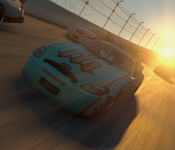
As the field attempted a final recovery, a surreal environmental factor took hold. Due to the accelerated time settings, the sun began a rapid descent, plunging the unlit superspeedway into a premature twilight. The visual landscape transitioned through a haunting blue haze before sinking into absolute pitch-blackness. Because Talladega lacks stadium lighting, the event became the “Car of Darkness” race, with drivers forced into a state of “blind racing” at Mach 10. The only illumination came from glowing dash gauges and scattered trackside lamps. The clock didn’t just run out on the competition; it ran out on the sun itself, leaving the field to thunder through the void on little more than muscle memory and the frantic instructions of their spotters.
Safety concerns finally overruled competitive drive, and officials made the unprecedented decision to call the race with four laps remaining. Ben Sheppard was declared the victor, having navigated the abyss with what he later called “X-ray vision,” crediting his spotter for guiding him through the zero-visibility conditions. Matt Watkins secured a hard-fought second place, followed by Brian Lynch in third. Dakota Pischke, who had been a protagonist all night, emerged from the wreckage and the darkness to claim a solid sixth-place finish. It was a bizarre, historic conclusion to a race for the history books—a surreal chapter where the OBRL field didn’t just cross the finish line; they disappeared into the Alabama night.