


Mastery in the Lone Star State: Theriault Silences the Field at Texas
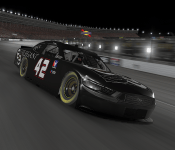
The Red Light Racing Checkered Flag Auto Supply Scrambler Series opened its five-race Chase at Texas Motor Speedway for Round 11, and the Lone Star State delivered a 90-lap test of speed, patience, and tire management. With 12 drivers now battling for the championship, the pressure was immediately turned up, and Texas proved to be a fitting place to begin the postseason. The track’s unusual combination of banking, corner shapes, and tire wear made it an especially difficult challenge for the O’Reilly cars, which were making their first appearance since Bristol on August 3.
Texas presents drivers with two very different ends of the racetrack. Turns 3 and 4 are relatively conventional high-speed corners, while Turns 1 and 2 feature a wider, lower-banked entry that can be both inviting and treacherous. Drivers approach Turn 1 at nearly 190 mph before slowing to roughly 150 mph at the apex. The narrow groove leaves little room for error, and getting back to the throttle too early can send a car toward the outside wall. With the O’Reilly cars appearing only twice during the Chase, the lack of recent seat time made tire management an especially important factor from the moment the green flag dropped.
Unlike many of the races seen throughout the season, the Texas event remained green from start to finish. That placed an enormous premium on qualifying and clean air because there would be no cautions to give drivers a chance to reset their race or regain lost track position. Pole sitter Trent Potter took advantage of the clean air in the opening stages, but Luke Logan Allen quickly emerged as his biggest challenger.
Starting from 12th, Allen wasted little time moving forward. The No. 31 used aggressive slingshot runs to close in on Potter, repeatedly looking for an opportunity to take control of the race. Allen’s approach through Turn 1 was particularly aggressive, entering lower than Potter and using additional steering input to rotate the car. While that line could produce a strong initial corner entry, it also placed additional lateral load on the right-front tire and threatened to accelerate tire wear. As the first quarter of the race passed, the battle between Potter and Allen gradually evolved into a test of who could manage the equipment better, with everyone knowing the eventual green-flag pit cycles would likely determine the winner.
Pit road quickly became the scene of several pivotal mistakes. The high rear-brake bias used by many drivers to help rotate the cars through the flat entry of Turn 1 can become a significant liability when transitioning onto the pit apron, and a driver who carries too much speed or locks the rear tires can easily find himself in trouble with the pit-road speed limit. Sean Single discovered that the hard way when the “Care Bear” machine drifted and slid during pit entry. The mistake resulted in a black-flag penalty and effectively removed Single from contention. Trent Potter suffered an even more damaging setback when he was caught speeding during the first pit cycle, taking the early leader out of the lead battle and eventually dropping him to a 16th-place finish.
James Skelton also had a sideways moment entering pit road, but he avoided a penalty and remained in position to fight for the podium. Skelton’s race was already shaping up to be one of perseverance. A force-feedback failure during qualifying left him starting well outside the front of the field, forcing him to work through traffic while also dealing with difficult conditions away from the racetrack. Despite those obstacles, Skelton kept his car clean and continued moving forward as the race unfolded.
While others struggled on pit road, Luke Logan Allen made a strategic move that helped keep him near the front. The No. 31 pitted earlier than several of his rivals, using the immediate advantage of fresh tires to maintain his position and establish a gap over Chris Hammett and Maxime Theriault. The race was beginning to settle into a classic long-run battle, with the leaders separated by strategy as much as outright speed. Theriault, meanwhile, was quietly setting himself up for the final act.
The seven-time series champion recognized that he had pushed his tires too hard during the opening stint. Rather than continuing to drive at the limit and sacrifice his equipment, Theriault deliberately backed down his pace through Turns 1 and 2 and focused on preserving the right-front tire. It was a calculated adjustment that would pay dividends later. As the final pit cycles approached, his patience began to show its value. While Allen had built an advantage earlier in the race, Theriault stayed out several laps longer during the final round of stops, giving himself a significant tire advantage once he finally came to pit road.
With fewer than ten laps remaining, Theriault emerged from the final pit sequence with a 2.5-second deficit to erase. For most of the race, that would have looked like an enormous gap, but the veteran began cutting into it at an astonishing rate. Using the draft on the long straightaways while maintaining his tires through the corners, Theriault steadily brought the No. 51 into striking distance. With six laps remaining, he dove to the inside of Allen and forced the No. 31 toward the marbles and dirt in Turn 4. Allen’s car slid up the track and lost the momentum he needed to defend the position, allowing Theriault to complete the pass and take control of the race.
From there, Theriault managed the final laps with the composure of a seven-time champion. After spending previous weeks as a consistent front-runner without the victory to show for it, he finally converted his pace and strategy into a Chase-opening win. His ability to recognize that he had overworked his tires early, adjust his driving style, and capitalize on the final tire cycle proved to be the difference between another strong finish and a trip to Victory Lane.
Allen held on for second after leading much of the race and coming within six laps of victory. While the late tire disadvantage was undoubtedly frustrating, a runner-up finish to begin the Chase still represents an important result for the No. 31 team. James Skelton completed the podium with one of the most impressive drives of the night, climbing from his difficult starting position to finish third.
Chris Hammett came home fourth, followed by Chris Worrell in fifth. David Odendahl finished sixth, Geoffrey Souza was seventh, Zach Mitchell took eighth, Ethan Troutman finished ninth, and Logan Spath rounded out the top ten. The results gave the Chase field an early indication of how quickly the championship picture can change when tire strategy becomes the deciding factor.
The Texas race was a caution-free clinic in tire management and strategy, and it provided an early glimpse at just how important patience will be during the five-race Chase. Theriault’s ability to recover from an overly aggressive opening stint and turn a 2.5-second deficit into a winning move in the closing laps was the defining performance of the evening.
For Allen, the challenge now moves to Rockingham, a track he clearly does not hold in particularly high regard. The runner-up joked afterward about his “hatred” of the North Carolina facility, suggesting that the track might be better suited for boat racing if it were simply filled with water. The Chase, however, has only just begun, and with four races remaining before the championship is decided at Charlotte, the rest of the field still has plenty of time to answer Theriault’s opening statement.



 Virtual Grip Network