Sirois Masters the Chaos to Clinch Retro Series Finale
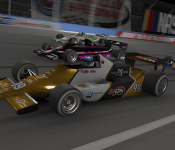
The Virtual Grip Network press box sat high above the two-mile oval of Auto Club Speedway as the sun dipped toward the San Bernardino Mountains, casting a warm golden-hour glow across the asphalt. It was August 31, 2026, the season finale of the Sim Gaming Expo ISRA Retro Series Throwback Season, and for the 15 drivers strapped into their high-force Lotus 79s, the championship pressure had already been lifted. Quebec powerhouse David Sirois had mathematically secured the title before the green flag, but there was still plenty at stake in the final round, including pride, bragging rights, and a custom championship ring. What followed over the next 75 minutes was a wild combination of high-speed draft battles, multi-car wrecks, strategic gambles, and the kind of late-race chaos that made Fontana an appropriate stage for the season finale.
From the drop of the green flag, the lack of championship pressure produced an aggressive atmosphere. Pole sitter Craig Forsythe, who had boldly predicted a victory at Fontana two rounds earlier, was immediately swallowed up by Chris Stofer. Stofer used the high line to power into the lead while Matt Wagner charged underneath him in a drag race for the top spot. Wagner’s light blue and yellow machine officially led the opening lap, but the field quickly settled into a roaring single-file train with less than two seconds separating first from last. Stofer went on to lead eight of the opening ten laps, while Wagner and Forsythe each grabbed a lap at the front.
The undisputed star of the opening stint was former real-world IndyCar driver Richie Hearn. Starting ninth, Hearn immediately began carving through the field and made an impressive outside pass on Alex Guyon to move into third. Broadcasters Bill “Soup” Zahn and Jeremy “Gridlock” Scott marveled at Hearn’s precision, joking that his heel-and-toe nimbleness must have come from childhood tap-dancing lessons. Behind the leaders, Cristobal Valenzuela of Chile was mounting a charge of his own, gaining six positions to move into the top five and put pressure on the front-runners.
With fuel runs expected to last approximately 32 to 35 laps, or roughly 25 minutes, strategy was always going to play a major role in the 75-minute event. Stofer and Hearn decided to gamble by making their first pit stops on Lap 32, roughly three laps before most of the field. The early stops provided clean air and fresh tires, but they also put both drivers on a much tighter fuel window for the remainder of the race. When the rest of the field came to pit road, the gamble became even more complicated as several drivers struggled with the heavily banked, high-speed pit entry.
Michael Goodman, Lionel Calisto, and Matt Wagner were among the drivers caught speeding on pit road, costing each of them valuable track position and dropping them a lap down. Stofer encountered a different problem when he stopped short of his pit box and was forced to reposition the car before beginning his service. The mistake cost him valuable time and handed the net lead of the pitted group to Hearn. What had looked like a potentially race-winning strategy for Stofer suddenly became a battle to recover lost ground.
The race’s biggest moment arrived after the halfway mark during a long green-flag run. Vern Hawkins, who was heroically driving “goofy-footed” while dealing with a severe right-foot cramp, became entangled with Craig Forsythe. The contact sent both cars sliding out of control, and second-place championship finisher Alex Guyon had nowhere to go. Guyon slammed into the wreckage, launching the cars into the catch fence and leaving both Guyon and Forsythe upside down on their lids.
“Guyon had nowhere to go… up into the catch fence, both of them on their lids for a while.” — VGN Broadcast
The resulting caution gave Michael Goodman a much-needed lifeline. As the first car one lap down, Goodman received the Lucky Dog and returned to the lead lap. Under the yellow, Stofer made another strategic decision to pit and top off his fuel, hoping the additional service would give him enough fuel to reach the finish. Instead, the move created another problem. Hearn was able to take a wave-around and return to the front, while Stofer became trapped behind the pace car and was buried deep in the field for the restart.
When the green flag returned with just under 28 minutes remaining, Fontana turned into a four-wide free-for-all. Lap-down cars, led by a desperate Lionel Calisto and Matt Wagner, refused to simply fall into line. Both needed another caution to have any realistic chance of returning to contention, and they raced aggressively at the front of the pack, occupying the lower lanes and forcing the actual leaders into increasingly risky maneuvers. Three-wide and four-wide formations became commonplace down the backstretch as drivers searched for any available piece of pavement.
Chris Ragan attempted to squeeze through a microscopic opening between Calisto and Wagner, while Chris Stofer, whose car had begun blinking dangerously because of network connection problems, fought his way back toward the top three. Even series organizer Mike Rigney found himself in the middle of the action. Rigney briefly joined the broadcast booth by radio while actively racing three-wide, relying on improvised spotting from Bill “Soup” Zahn in the booth to survive the squeeze. At Fontana, even the people calling the race were seemingly unable to escape the chaos.
As the final pit window opened with less than ten minutes remaining, the race became a test of fuel conservation. Most of the field had spent the preceding stint running flat-out through the four-wide battles and now needed substantial fuel during their final stops. Michael Goodman also required repairs after scraping the wall, while another collection of speeding penalties caught Rigney, Ryan O’Donoghue, Garry Lovern, and Richie Hearn. The late pit cycle scattered the field and opened the door for one driver who had been quietly playing a very different game throughout the race.
David Sirois had spent the entire event carefully managing his fuel. While others burned through their reserves battling for every inch of track position, the newly crowned champion was thinking about the final stop and the number of laps he could stretch from each tank. Sirois managed to run one lap longer than the rest of the field on his second stint, allowing him to pit later and take significantly less fuel. His final stop lasted only 11 seconds, compared with the roughly 12.5-second benchmark of the other front-runners, and the difference was enough to put him back onto the track with a 1.3-second advantage.
Sirois’s teammate, Alex Guyon, then played a critical role in protecting that advantage. Despite the damage from his earlier catch-fence crash and being several laps down, Guyon positioned his car perfectly to provide Sirois with a crucial aerodynamic draft. Behind them, Cristobal Valenzuela and Chris Ragan were charging hard, but Sirois’s fuel-saving strategy and Guyon’s assistance kept the leaders from closing the gap. The final-lap crash involving Richie Hearn and Craig Forsythe only added another layer of drama to an already chaotic finish.
David Sirois crossed the start-finish line to secure his seventh victory of the season and put a fitting exclamation point on his championship campaign. The win was not simply a product of outright speed. Sirois had recognized that fuel conservation could become the decisive factor, managed his resources while the rest of the field fought through the chaos, and then executed the final stop exactly when he needed to. After 75 minutes of racing, the championship was already his, but Sirois proved that he had no intention of simply cruising to the finish.
Cristobal Valenzuela produced one of the most spectacular finishes of the night, crossing the line while physically sliding sideways through the grass to secure a top-five finish. Chris Stofer recovered from his pit-road mistake to finish second after leading 58 laps, while Michael Goodman completed the podium after using the Lucky Dog to recover from his earlier penalty. Chris Ragan finished fourth, followed by Valenzuela in fifth.
After the race, Sirois credited his victory to patience and fuel strategy, explaining that he had been saving fuel throughout the event, allowing him to run one additional lap before making his final stop. The later pit entry meant he required less fuel, while Guyon’s drafting assistance helped keep the pursuing pack at bay. For Sirois, it was the perfect combination of preparation, strategy, and teamwork to close out a championship season with another trip to Victory Lane.
Chris Stofer was left to reflect on what might have been after starting near the front and spending much of the race in contention. His early pit stop and qualifying position put him in an excellent position, but stopping short in his pit box cost him valuable time. The second pit stop under caution then buried him in traffic, forcing him to fight his way back through the field before ultimately recovering to finish second.
Michael Goodman had his own roller coaster of a night. His speeding penalty during the opening pit sequence initially dropped him a lap down, but the caution and Lucky Dog later in the race gave him a second chance. After surviving the restart chaos and making his way back toward the front, Goodman held on for third and admitted afterward that the intensity of the race had left his blood pumping.
The championship celebrations continued after the checkered flag. Sponsor Jim Herrick of 4D Racewear announced that David Sirois would receive a custom-designed championship ring, while the top three finishers would earn gift certificates for premium sim-racing gear. Pole sitter Craig Forsythe also walked away with the season’s random Participation Award despite his difficult night, earning a one-year iRacing subscription and a custom ISR ball cap.
As the virtual sun finally disappeared over Fontana, the ISRA Retro Series Throwback Season came to a close. The finale delivered everything the series could have asked for: aggressive drafting, spectacular crashes, strategic gambles, unlikely recoveries, and a champion who sealed the deal by outthinking the field when it mattered most. David Sirois may have arrived at Auto Club Speedway with the championship already secured, but he left California with his seventh win of the season and one final reminder that in the Retro Series, even a championship victory lap can turn into a full-throttle fight to the finish.